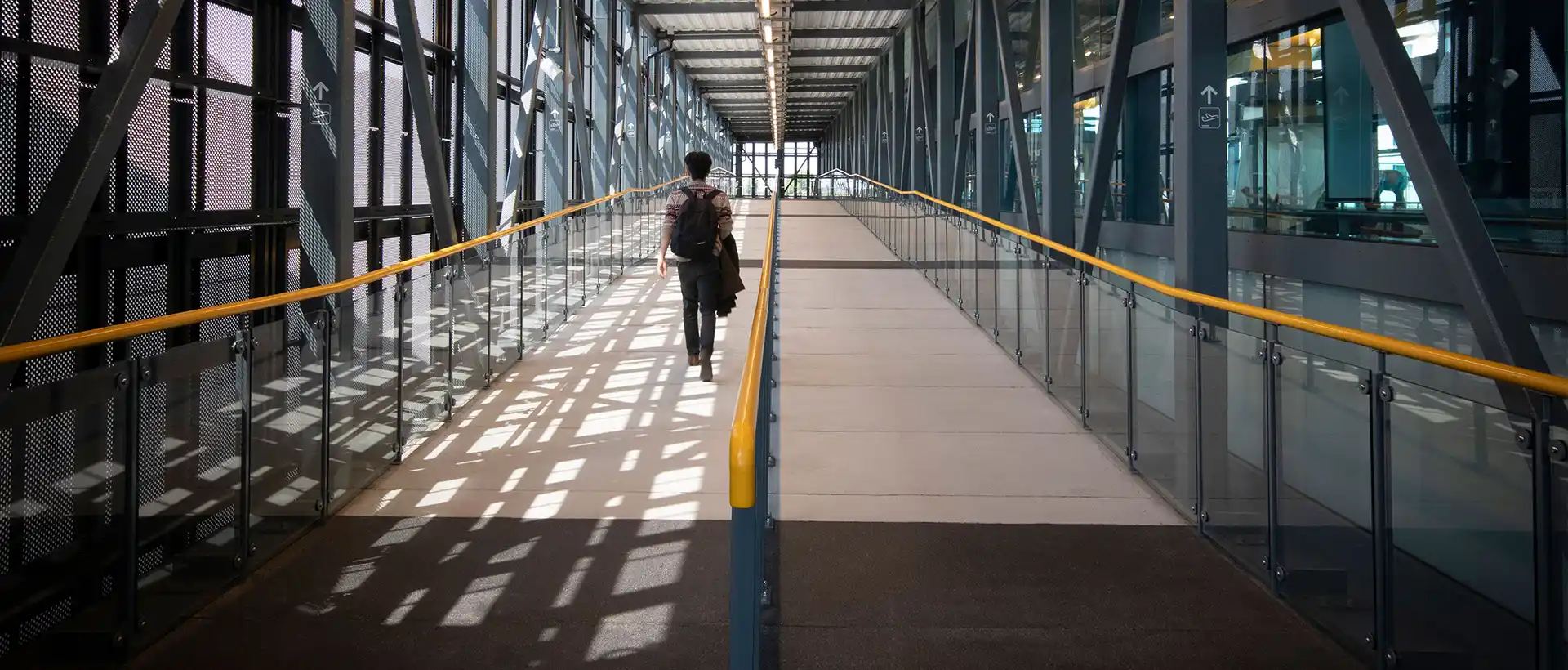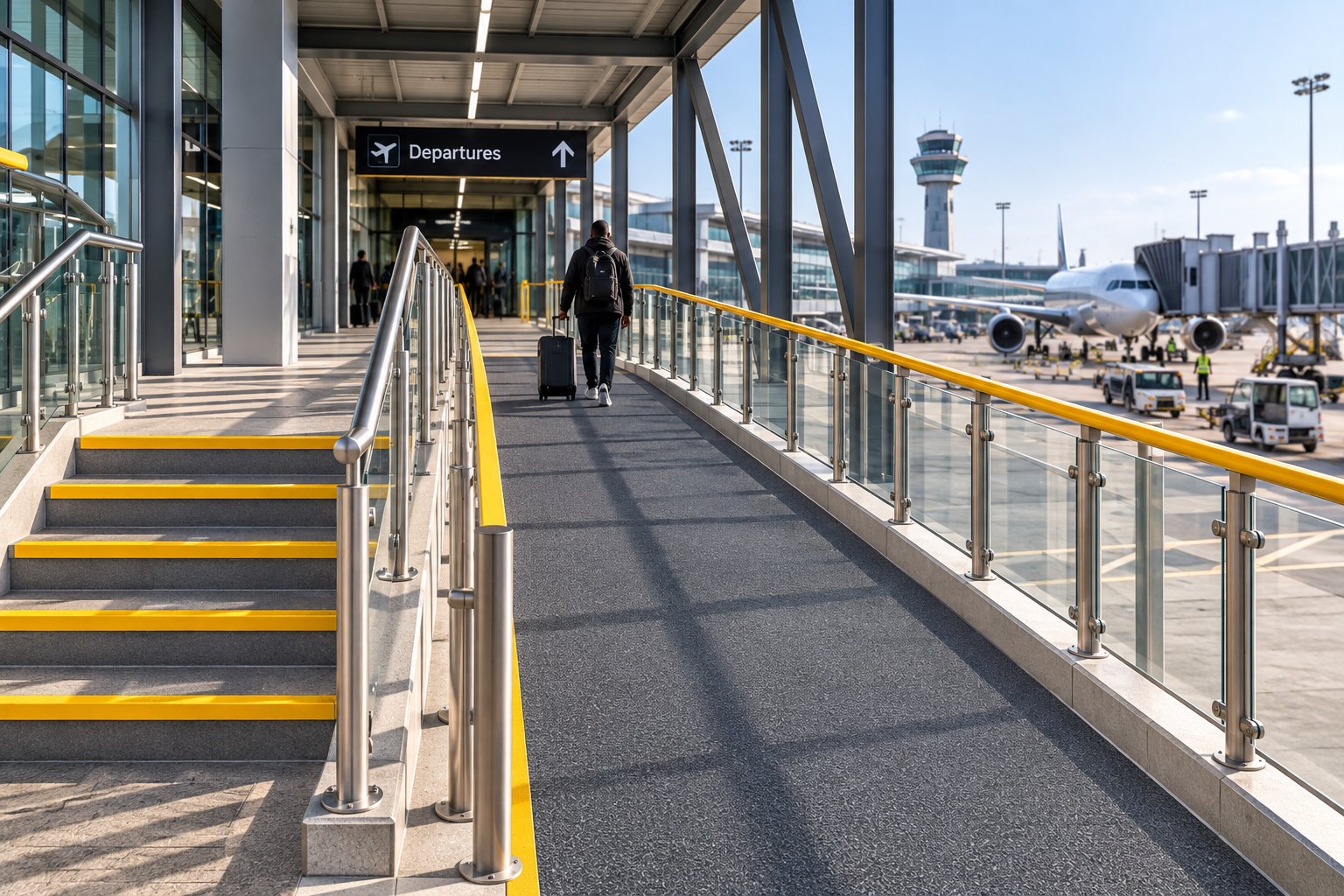
An airport doesn’t have one floor.
To a passenger, it may feel like one continuous journey from the terminal entrance to the boarding gate. For the facilities, health and safety and operations teams responsible for the airport, however, that journey crosses multiple environments, each with different flooring challenges.
An external walkway may be exposed to seasonal rainfall, dust and windblown debris. A ramp may carry passengers with wheeled luggage, staff with equipment and maintenance teams throughout the day. A staircase needs suitable grip, but also clearly defined step edges. Even two areas only a few metres apart can require very different approaches.
That is why choosing anti-slip flooring for an airport should start with the environment, not the product. The right solution depends on what is happening in the area and how that route is actually used.
Why Airport Flooring Needs to Be Assessed Area by Area
South African airport environments can place very different demands on pedestrian routes. Exposed areas may need to cope with strong sunlight, rainfall, dust and temperature changes, while covered routes may still experience moisture and dirt carried in from outside. At the same time, airport flooring needs to accommodate people who are often moving quickly, pulling luggage or using trolleys.
The starting point should therefore not be “Which COBAGRiP® product do we need?” It should be: “What is happening in this area?”
A proper assessment should consider factors such as the environment, traffic, existing surface, likely contaminants, drainage, maintenance and wheeled access. Once those conditions are understood, it becomes much easier to identify whether the area needs COBAGRiP® Sheet, COBAGRiP® Stair Treads or COBAGRiP® Stair Nosing.
External Airport Walkways: When the Existing Surface Needs More Grip
External walkways can connect terminals, parking areas, drop-off zones, service buildings and other parts of an airport. These routes may be exposed to rain, dust and debris while handling regular pedestrian traffic and wheeled luggage.
The issue is not always the entire floor. In many cases, the existing substrate may still be structurally suitable, but the surface itself requires additional grip. Replacing the complete walkway may therefore be unnecessary if the main challenge is traction.
Where the existing surface remains suitable, COBAGRiP® Sheet can be installed over it by bonding or mechanical fixing. It is designed for internal and external walkways and provides a durable anti-slip surface.
This allows airport facilities teams to address a specific flooring issue while retaining the existing substrate where appropriate, rather than automatically turning it into a complete replacement project.
Ramps and Access Routes Need More Than Just an Anti-Slip Surface
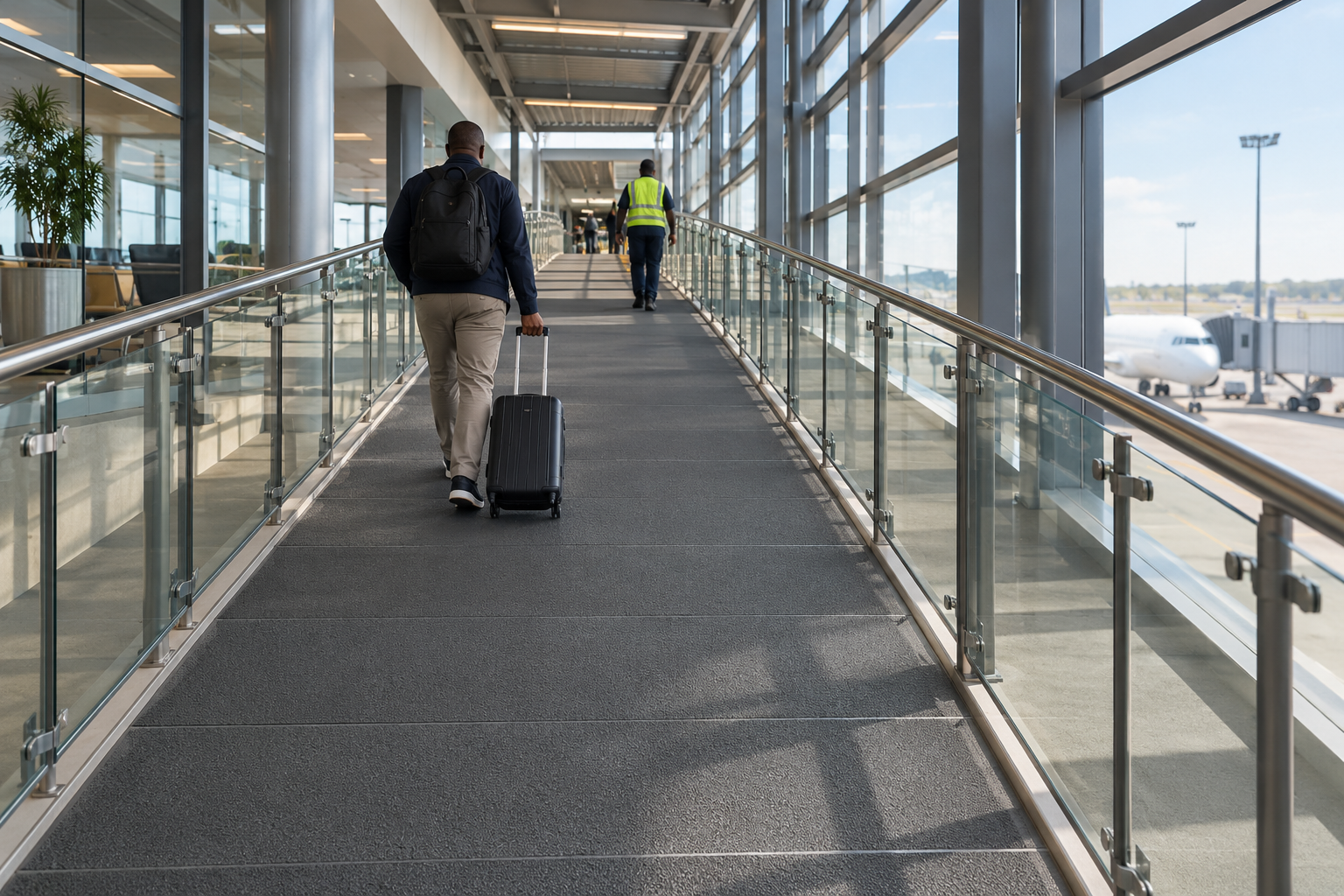
A ramp may look like a simple section of airport flooring, but the way it is used can be much more complicated. Passengers may be pulling wheeled luggage, staff may be moving trolleys or equipment, and maintenance teams may need regular access.
This means specifying an anti-slip flooring solution based purely on grip can overlook how the route functions as a whole.
The gradient, drainage and movement across the route all matter. Where the underlying ramp remains sound but the surface requires additional traction, COBAGRiP® Sheet may provide a practical retrofit option because it can be installed over an existing floor.
The important part is not simply choosing a sheet because extra grip is needed. It is understanding how people and equipment use the route and specifying around those demands.
A properly assessed access route can therefore provide improved traction without creating unnecessary complications elsewhere in the pedestrian journey.
Airport Stairs: Grip Is Only Part of Stair Safety

Stair safety is not just about whether a step feels slippery.
Step edges also need to be easy to identify, particularly in busy airport environments where people may be carrying bags, pulling luggage or moving through an unfamiliar building. External stairs can present an additional challenge because rain, dirt and changing weather conditions can affect the surface.
The key question is whether the issue affects the whole tread or primarily the leading edge.
Where the full stair surface needs additional grip, COBAGRiP® Stair Treads cover the tread area and extend over the front edge of the step. Where the existing tread remains suitable but the leading edge needs greater grip or visibility, COBAGRiP® Stair Nosing provides a more targeted solution.
Choosing between Stair Treads and Stair Nosing should therefore depend on the condition of the staircase and the specific safety requirement.
This allows airport teams to improve anti-slip stair safety without carrying out unnecessary work to parts of the staircase that are still performing as required.
Service and Operational Access Routes Need Their Own Assessment
Not every pedestrian route in an airport is passenger-facing. Maintenance teams, ground staff and other operational employees may use service walkways, access routes and stairs that experience very different demands from public areas.
The same principle applies: specify according to the route, not simply the location.
If an existing walkway requires additional grip, COBAGRiP® Sheet may be suitable. Where a staircase is the main concern, Stair Treads or Stair Nosing may provide a more appropriate solution.
This is particularly relevant in airports, where a public pedestrian route and a maintenance access route can sit alongside each other while performing completely different functions.
What Should You Assess Before Choosing Anti-Slip Flooring?
The right solution starts with understanding the area.
Environment
Is the route indoors, outdoors or partially covered? Will it be exposed to rain, dust, direct sunlight or changing temperatures? A sheltered access route may require a different approach from a fully exposed external walkway.
Existing Substrate
What surface is already in place, and what condition is it in?
COBAGRiP® Sheet can be installed over a suitable existing floor, so where the substrate remains sound, it may be possible to improve the walking surface without removing the complete floor.
Traffic
How is the area actually used?
A route may carry passengers, employees, wheeled luggage, trolleys or maintenance equipment. Traffic type and volume can influence both product selection and installation.
Contaminants
Water is only one consideration. Dust, dirt and other contaminants can affect traction and cleaning requirements, particularly on routes exposed to outdoor conditions.
Maintenance
How will the area be cleaned and inspected?
Maintenance should be considered from the start so the chosen GRP anti-slip solution works with the airport’s existing cleaning procedures.
Pedestrian and Wheeled Access
Airport routes often serve several users at once. Passengers may be walking with suitcases while staff move trolleys or other equipment through the same area.
The surface should therefore be considered as part of the complete route rather than as an isolated floor treatment.
Why GRP Can Be Useful When the Existing Airport Surface Is Still Sound
Airport flooring improvements do not always require a complete replacement.
Sometimes the problem is localised: a walkway requires additional grip, a ramp needs more traction or an existing staircase needs improved grip and step definition.
This is where the COBAGRiP® GRP range can provide useful retrofit options. COBAGRiP® Sheet can be installed over an existing suitable surface, while Stair Treads and Stair Nosing can be used to improve new or existing steps.
The advantage is not simply the product itself. It is the ability to address the specific floor-level challenge while making use of existing surfaces where they remain suitable.
One Airport. Multiple Environments. Different Anti-Slip Solutions.
An airport may look like one continuous facility, but its flooring conditions can change within a few metres.
An external walkway exposed to rain presents a different challenge from a ramp carrying wheeled luggage. A full stair tread requiring more grip is different from a staircase where only the leading edge needs attention. A maintenance route may experience completely different traffic from the passenger route beside it.
That is why specifying anti-slip flooring should begin with the application rather than the product.
COBA can help assess the area and identify the most appropriate solution from the COBAGRiP® Sheet, Stair Tread and Stair Nosing range.