Grounding: The Most Common Point of Failure
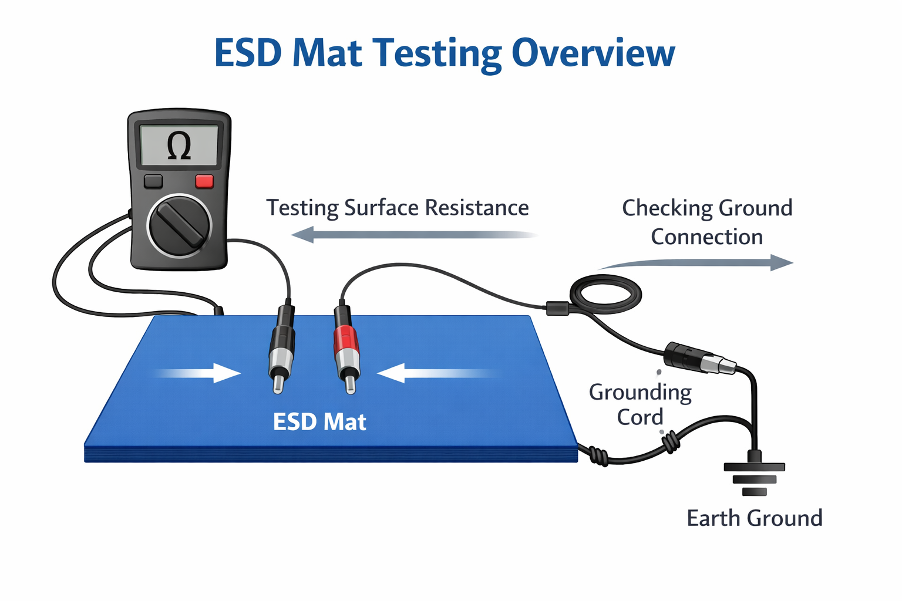
Even correct resistance values mean little without a verified earth connection. An ESD mat grounding test confirms that static charge has a continuous, uninterrupted path to ground.
Loose connections, damaged cords or incorrect earthing points are common issues uncovered during testing. Regular checks of grounding ESD mats and ESD mat continuity testing are essential to maintaining compliance over time.
How Often Testing Should Happen
There is no single schedule that fits every environment. High-risk or high-traffic areas may require frequent testing, while controlled environments can follow longer intervals.
What matters most is consistency. A documented testing routine supports ESD mat compliance and provides evidence during audits, inspections or internal safety reviews.
What Standards ESD Testing Is Based On
ESD mat testing is not arbitrary. Resistance ranges, grounding requirements and test methods are defined by recognised international standards.
The most widely referenced framework for ESD control is IEC 61340, which outlines acceptable resistance ranges, testing methods and system requirements for controlling electrostatic discharge. These standards focus on ensuring static electricity is dissipated in a controlled and predictable manner rather than blocked entirely.
In South Africa, ESD testing is often reviewed alongside broader electrical safety requirements. However, ESD performance itself is assessed against IEC 61340 principles, not electrical insulation standards. Understanding which standard applies is essential when reviewing compliance or audit requirements.
Equipment Used for ESD Mat Testing
Testing ESD mats typically requires specialised resistance and continuity measurement equipment designed for static control applications.
Common tools used during ESD mat testing include:
- Surface resistance meters with appropriate test electrodes
- Continuity testers for verifying grounding paths
- Earth bonding verification tools
These instruments allow resistance readings and grounding paths to be measured accurately without damaging the mat or the surrounding installation.
Using general electrical test equipment not designed for ESD applications can produce misleading results. For this reason, testing should always be carried out using equipment intended for static control verification and in line with recognised testing procedures.
The Mistakes That Undermine ESD Control
The most common failures are not technical — they’re procedural. Assuming anti-static performance equals ESD control, testing only at installation, or skipping grounding checks all create hidden risk.
ESD systems fail quietly. Testing is how that silence is broken.
The Result: Verified Control, Not Assumed Safety
When ESD mat testing is done correctly, organisations gain confidence — not just in their equipment, but in their compliance decisions.
Reliable testing reduces uncertainty, supports audits, and ensures static control systems continue to protect sensitive environments as intended.
For a broader view of how ESD control systems work as a whole, see our complete guide to ESD mats and static-safe workspaces.