


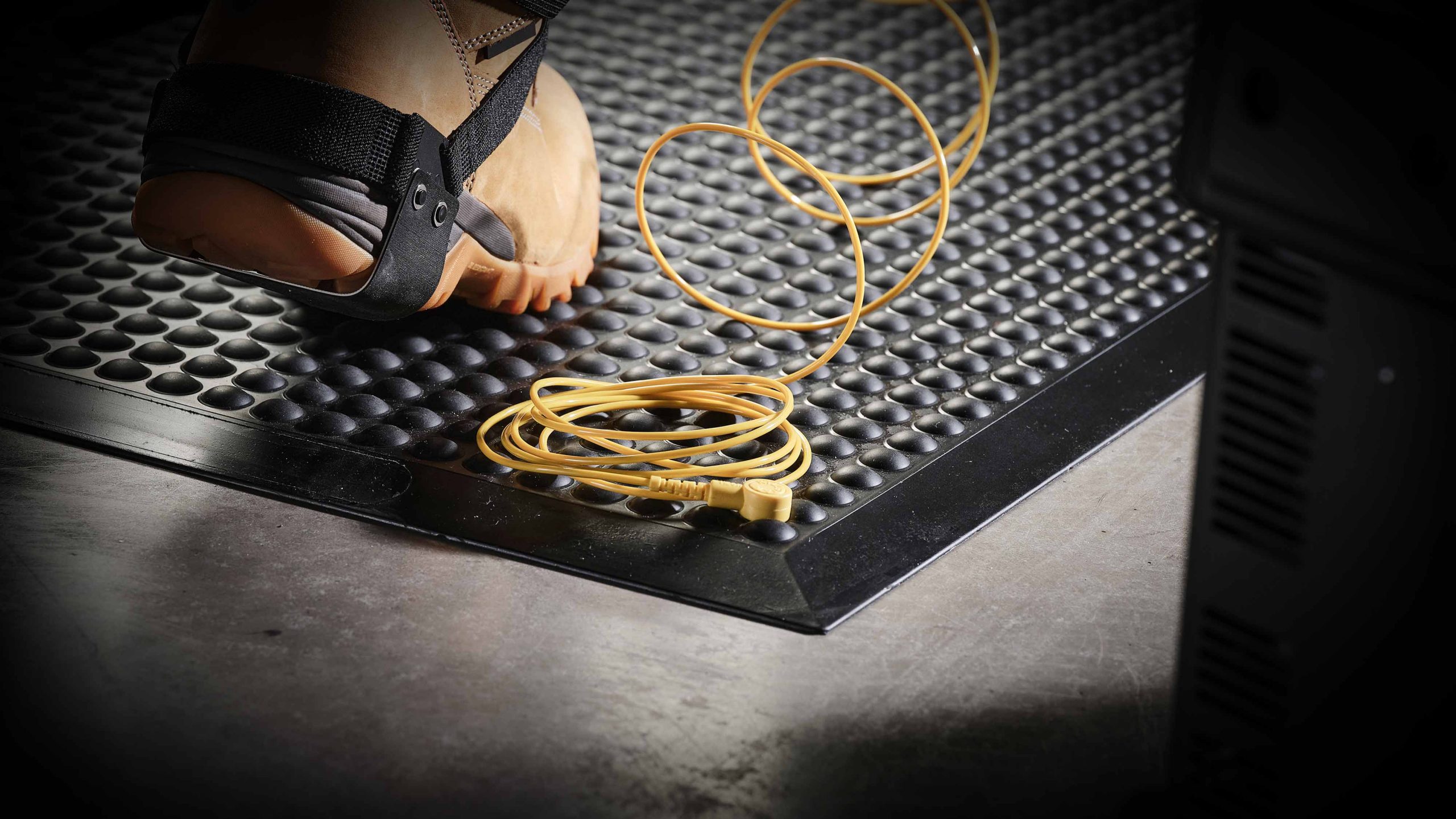
The Problem: The Spark You Never See Coming
Static electricity builds silently. A person walks across the floor. A tool slides across a bench. A component is placed down.
Each action transfers electrons from one surface to another.
Most of the time, nothing happens.
Then a single discharge reaches a sensitive component and the damage is already done. It may not fail immediately, but the reliability is compromised.
Electrostatic discharge is invisible, unpredictable and costly. That is why ESD control is essential wherever sensitive electronics are handled.
Static Is Not an Accident. It’s a Process.
Static is created through everyday movement. Clothing, footwear, tools and surfaces all contribute to charge build-up.
Without a controlled path to earth, that charge will discharge at the first opportunity.
ESD mats exist to control this process. They do not eliminate static. They manage it safely.

What Are ESD Mats?
ESD mats are engineered surfaces designed to dissipate static electricity in a controlled and predictable way.
They are manufactured from conductive or static-dissipative materials and must be connected to earth to function correctly.
ESD mats are commonly used on:
- Floors
- Workbenches
- Assembly tables
- Inspection stations
They form the physical foundation of a static-safe environment.
Floor That Stops Static Before It Reaches the Work
ESD Floor Mats
Every step generates voltage. If operators are not grounded, that voltage transfers directly into whatever they touch next.
ESD floor mats provide a safe pathway for static to flow to earth, reducing the voltage carried by personnel as they move through the workspace.
Used correctly, ESD floor mats:
- Stabilise operator voltage
- Reduce sudden discharge events
- Support controlled ESD zones
- Work alongside grounding accessories such as heel grounders
They are particularly important in areas with frequent movement between workstations.
The Bench Where Failures Either Start or Stop
ESD Bench Mats
Most ESD damage happens at the bench. This is where hands, tools and sensitive components interact directly.
An ESD bench mat creates a controlled working surface that keeps everything at the same electrical potential.
This prevents uncontrolled discharge when components are handled or tools are placed on the surface.
A grounded bench mat becomes the centre of the ESD-safe workstation.
The Biggest Misunderstanding: Anti-Static Is Not ESD Safe
Anti-static materials reduce static build-up.
They do not safely dissipate charge.
They do not protect electronics.
Only conductive and dissipative materials qualify as ESD safe. Every ESD mat is anti-static. Not every anti-static mat is ESD safe.


