 Static damage doesn’t happen because systems are missing.
It happens because they are incomplete.
An ESD grounding system is what turns static control from theory into protection. Without it, even the best mats cannot do their job.
The Invisible Risk: Why Grounding Is Critical in ESD Environments
Static electricity is always present. Movement, contact and separation between materials constantly generate charge.
The problem is not the creation of static.
The problem is what happens when it has nowhere to go.
Grounding provides a controlled path for static electricity to safely flow to earth. In ESD environments, all conductive elements, including mats, tools and operators, must be connected to the same ground point.
This equalises electrical potential and prevents sudden discharge.
Without grounding, static builds silently until it finds its own path. That is when damage occurs.
The common Mistake: Why ESD Mats Fail Without Grounding
There is a widespread misunderstanding that ESD mats “remove” static.
They don’t.
They are designed to dissipate static in a controlled way, but only when connected to earth.
Without a proper grounding connection:
- Static charge remains on the surface
- The mat becomes ineffective
- Sensitive electronics remain exposed
Even high-quality grounding mats for electronics require an ESD grounding wire to function correctly.
An ungrounded mat is not a safety measure. It is a false sense of security.
The System That Makes It Work: Key Components of an ESD Grounding System
An effective ESD grounding system is not a single product. It is a connected system where every component plays a role.
Grounding. cords: The pathway to earth
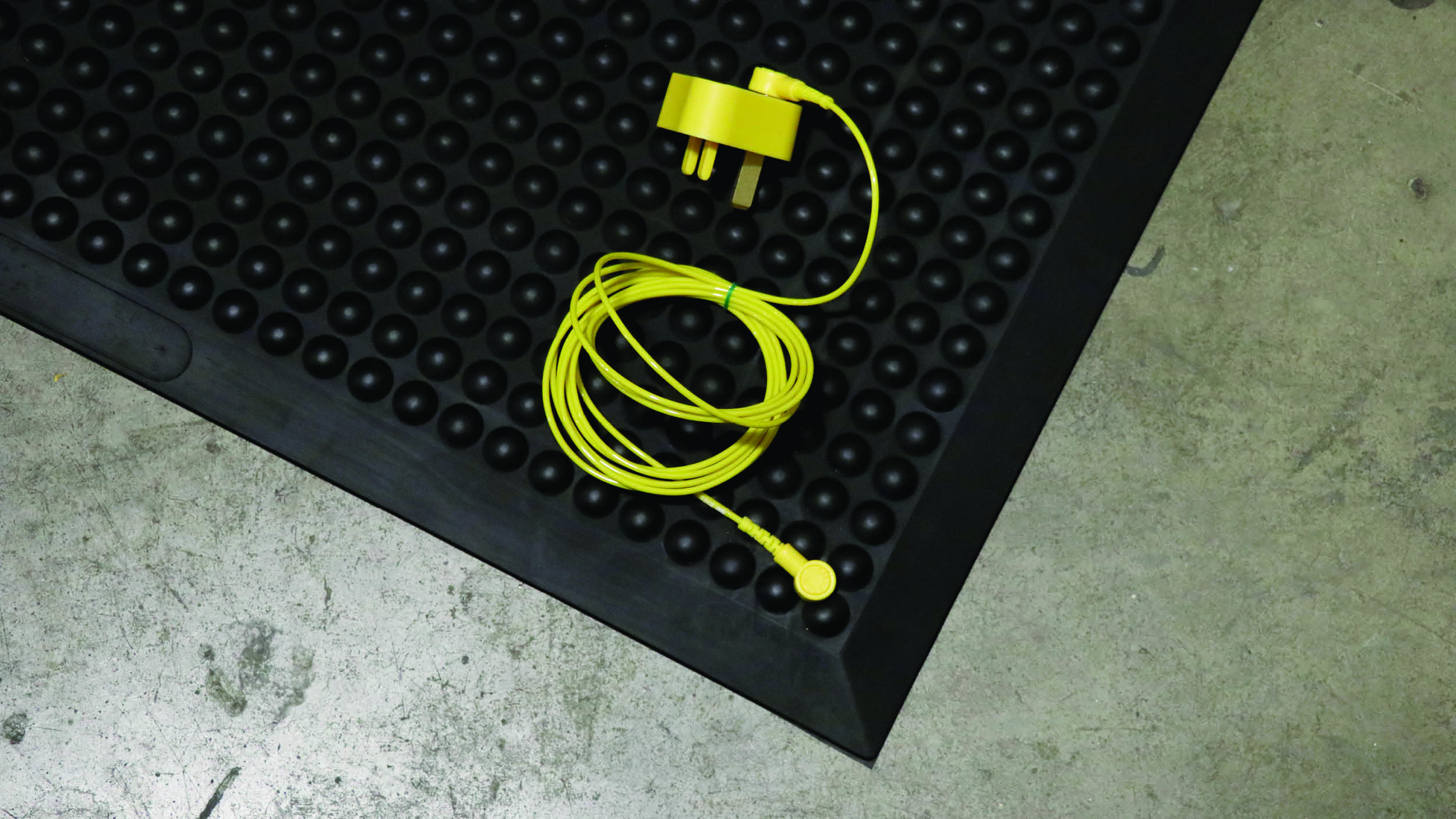
Grounding cords create the direct link between ESD mats and a verified ground point.
They allow static to move safely away from the surface and into earth. Common options include floor mat grounding wire and bench grounding leads.
Without this connection, the system is incomplete.
Earth bonding plugs: The simplest route to compliance
An earth bonding plug connects the ESD system directly to electrical earth through a standard socket.
This provides a reliable and practical grounding solution without the need for permanent installation, making it ideal for adaptable workspaces.
Common point ground: One system, one reference point
A common point ground allows multiple elements, such as mats and wrist straps, to connect to a single grounding location.
This ensures that everything operates at the same electrical potential and prevents voltage differences between components.
ESD mat with grounding cord: The foundation of the system
An ESD mat with grounding cord forms the base of most static control setups.
The mat dissipates static across its surface. The grounding cord ensures that charge has a safe path to earth.
Without the cord, the mat cannot function as part of a complete ESD grounding system.
Where It Goes Wrong: Common Grounding Mistakes
Most ESD failures are not caused by poor products.
They are caused by incorrect setup.
Typical issues include:
- Using ESD mats without grounding them
- Connecting to unsuitable or insulated surfaces
- Not using a common grounding point
- Loose or damaged grounding wires
- Multiple grounding points creating voltage differences
These mistakes reduce protection and increase the risk of hidden damage that may only appear later in product performance.
Proof, Not Assumption: Why Testing and Compliance matter
An ESD grounding system cannot be judged by appearance. It must be verified.
Over time, connections loosen, components wear, and performance changes.
Resistance testing confirms:
- Static is being safely dissipated
- Grounding connections remain intact
- The system meets required standards
Without testing, faults remain invisible and compliance requirements may not be met.