Some of these cookies are essential, while others help us to improve your experience by providing insights into how the site is being used.
For more detailed information, please consult our Privacy Notice
Analytics cookies
Analytical cookies help us to improve our website by collecting and reporting information on its usage. You can opt-out here.
Functionality cookies
Functional cookies help to improve your user experience when navigating our website. You can opt-out here.
Advertising cookies
Advertising cookies, including retargeting scripts, tailor ads to your interests based on your online activity, enhancing your browsing experience. You can opt-out here.
ESD Mat Resistance Explained: Understanding the Correct ESD Mat Resistance Range
COBA > COBA Africa > ESD Mat Resistance Explained: Understanding the Correct ESD Mat Resistance Range
In workplaces where electronic components are handled, static electricity rarely appears as an obvious hazard. A technician walks across the floor. A tool slides across a workbench. A circuit board is placed down for inspection.
Each movement transfers small electrical charges between surfaces.
Most of the time nothing happens. But when that charge suddenly discharges into a sensitive component, the damage may already be done.
Static electricity is invisible, unpredictable and often misunderstood. That is why many electronics environments rely on ESD control systems to stabilise electrical charge before it reaches critical equipment.
One of the most important factors in these systems is ESD mat resistance.
Understanding the correct ESD mat resistance range ensures static electricity moves safely and predictably to ground while protecting sensitive electronics.
ESD Mats: The Foundation of a Static-Safe Workspace
For a broader explanation of how ESD mats support static-safe workspaces, read our guide:
The surface resistance of ESD mats determines how easily electrical charge can move across the mat.
Resistance is measured in ohms (Ω). In simple terms, ohms describe how much a material slows the movement of electricity.
In static-controlled environments, the goal is not to eliminate electricity completely. Instead, electrical charge must be allowed to travel slowly and safely to ground.
If resistance is too low, electrical charge may travel too quickly and discharge suddenly.
If resistance is too high, static electricity may remain trapped on the surface instead of dissipating.
Because of this, ESD mats are designed to operate within a controlled resistance range that allows static electricity to move gradually and predictably toward earth.
Understanding ESD mat ohms helps organisations select surfaces that manage static electricity in a controlled and reliable way.
Fast or Controlled? Conductive vs Dissipative ESD Mats
Not all ESD mats behave the same way.
Two material categories are commonly used in static control environments: conductive and dissipative ESD mats.
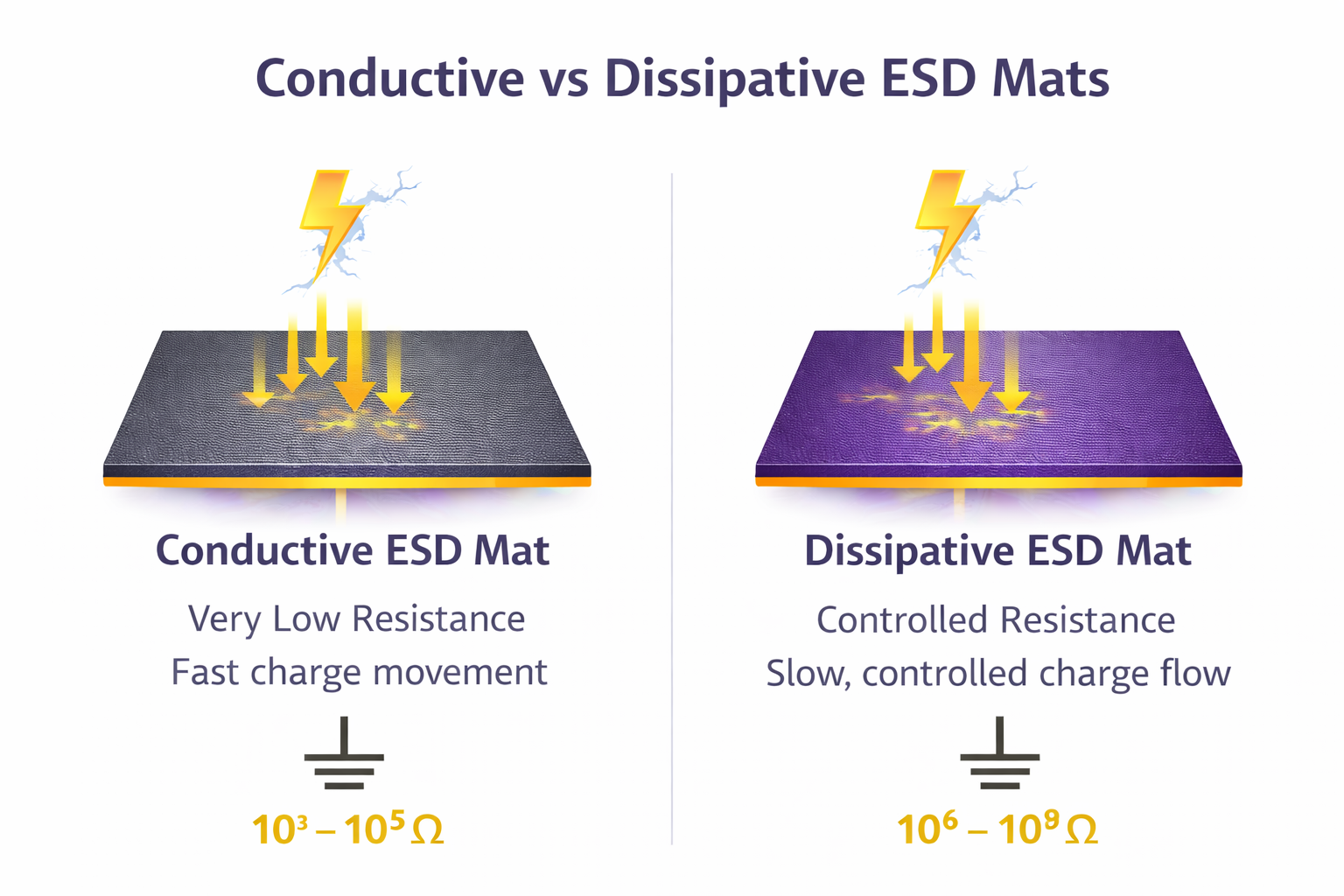
Conductive mats have very low electrical resistance. This means electrical charge moves quickly across the surface and reaches ground rapidly.
Dissipative mats have slightly higher resistance. This allows electrical charge to move more slowly, preventing sudden electrostatic discharge that could damage sensitive electronics.
For many electronics manufacturing and repair environments, dissipative materials provide the most controlled approach to static dissipation.
Understanding the difference between conductive vs dissipative ESD mats helps buyers choose the correct material for electronics assembly, testing and inspection work.
The Resistance Range That Protects Electronics
ESD mats are engineered to function within defined resistance levels.
International electrostatic control frameworks such as IEC 61340 outline recommended resistance ranges for surfaces used in static-controlled environments.
Many static-dissipative surfaces fall within an ESD mat resistance range of approximately 10⁶ to 10⁹ ohms.
This range allows electrical charge to move slowly across the surface and safely reach ground without creating sudden discharge events.
Maintaining resistance within this range helps workplaces control static electricity while protecting sensitive electronic equipment.
These values form part of the broader IEC 61340 resistance requirements used in electrostatic discharge protection systems.
Why Resistance Changes Over Time
Even when the correct mat is installed, its performance can change over time.
Daily use introduces factors that influence electrical resistance, including:
• dust and contamination
• cleaning chemicals
• humidity changes
• mechanical wear from foot traffic or equipment
Regular testing confirms that mats continue operating within the correct resistance range and that static control measures remain effective.
Where ESD Mats Fit in a Static Control System
ESD mats rarely operate in isolation. They form part of a wider electrostatic control system designed to manage electrical charge throughout the workspace.
A complete static control environment may include:
grounded floor mats that stabilise operator voltage
ESD work surfaces used during electronics assembly
anti-static accessories such as wrist straps
• common grounding point ESD connections
• bonding cords linking equipment to ground
Together, these elements create a controlled pathway for electrical charge to move safely to earth.
This controlled environment helps protect sensitive electronics used in manufacturing, inspection and repair processes.
Choosing the Correct ESD Mat Resistance Range
Selecting the correct ESD mat resistance range is an important decision when specifying static control surfaces.
Different environments require different levels of resistance depending on how static electricity needs to be controlled.
For example, electronics assembly workstations often rely on dissipative materials that allow charge to move slowly and predictably toward ground.
In other environments where grounding is critical, lower resistance materials may be used to ensure electrical charge dissipates quickly.
Understanding ESD mat resistance helps buyers choose surfaces that balance electrical safety, equipment protection and compliance with electrostatic control standards.
When the correct resistance range is selected, ESD mats help protect sensitive electronics, reduce hidden reliability failures and support safe working environments where static electricity must be controlled.
Stay Up to Date
Get the latest floor safety articles, product updates and offers.