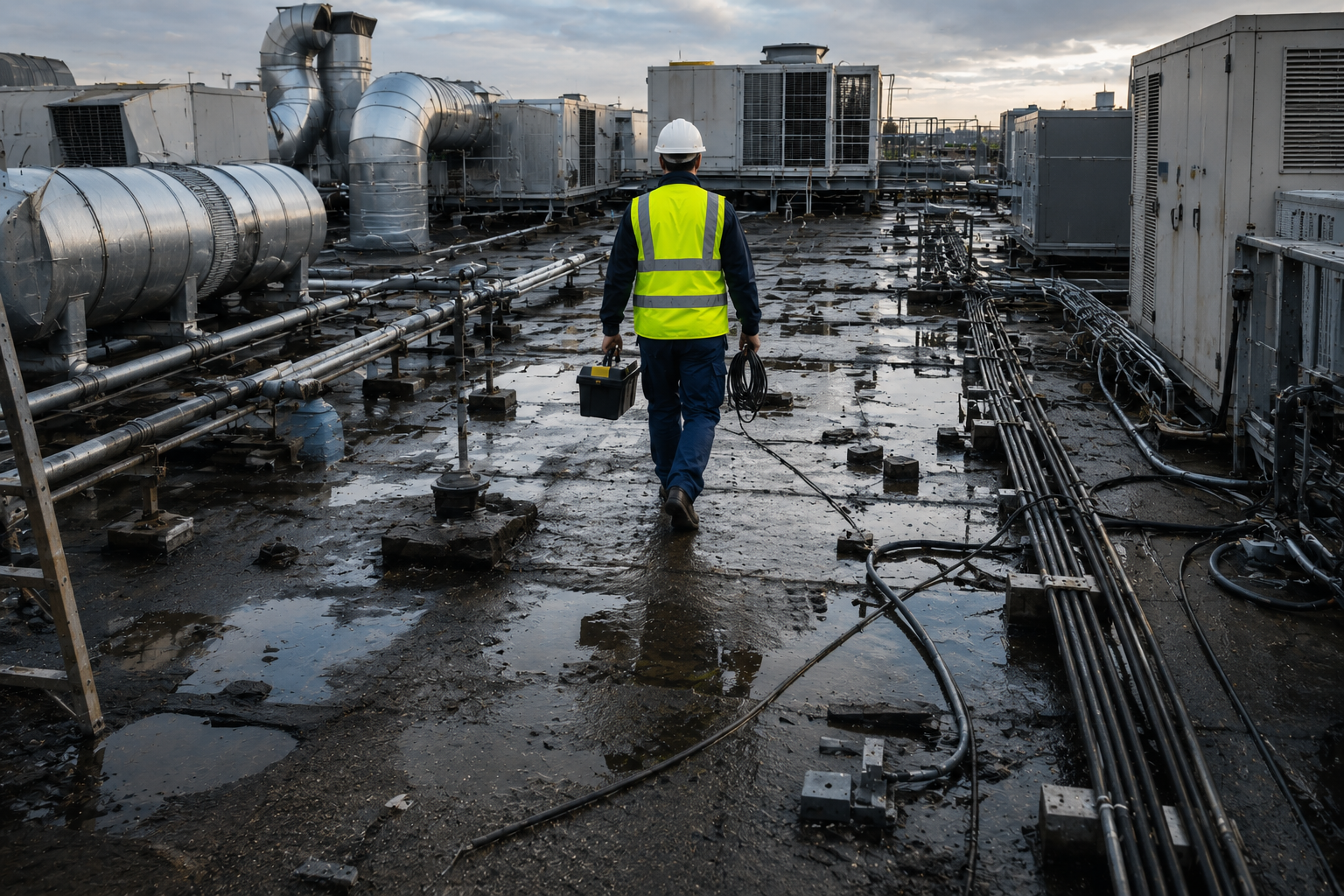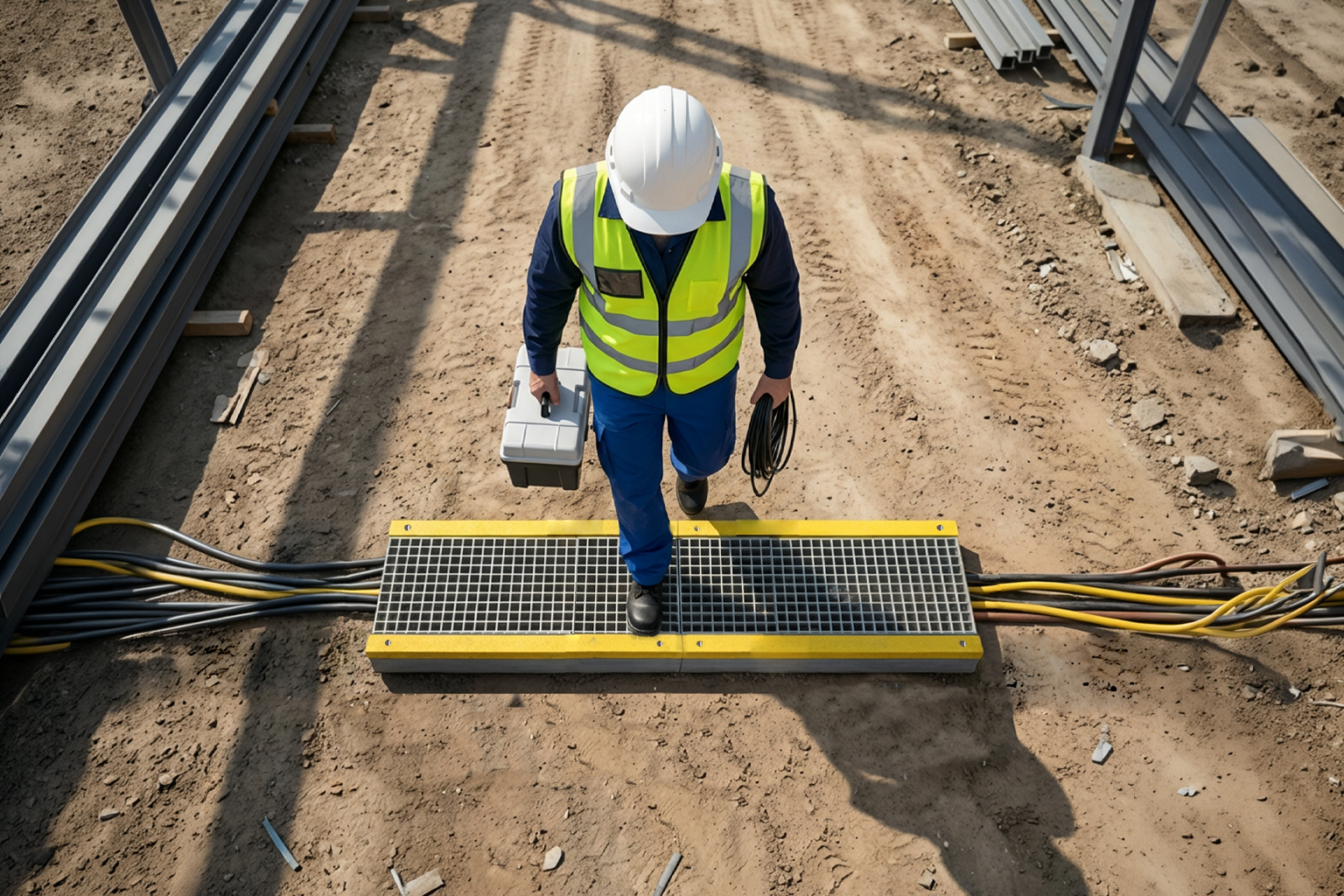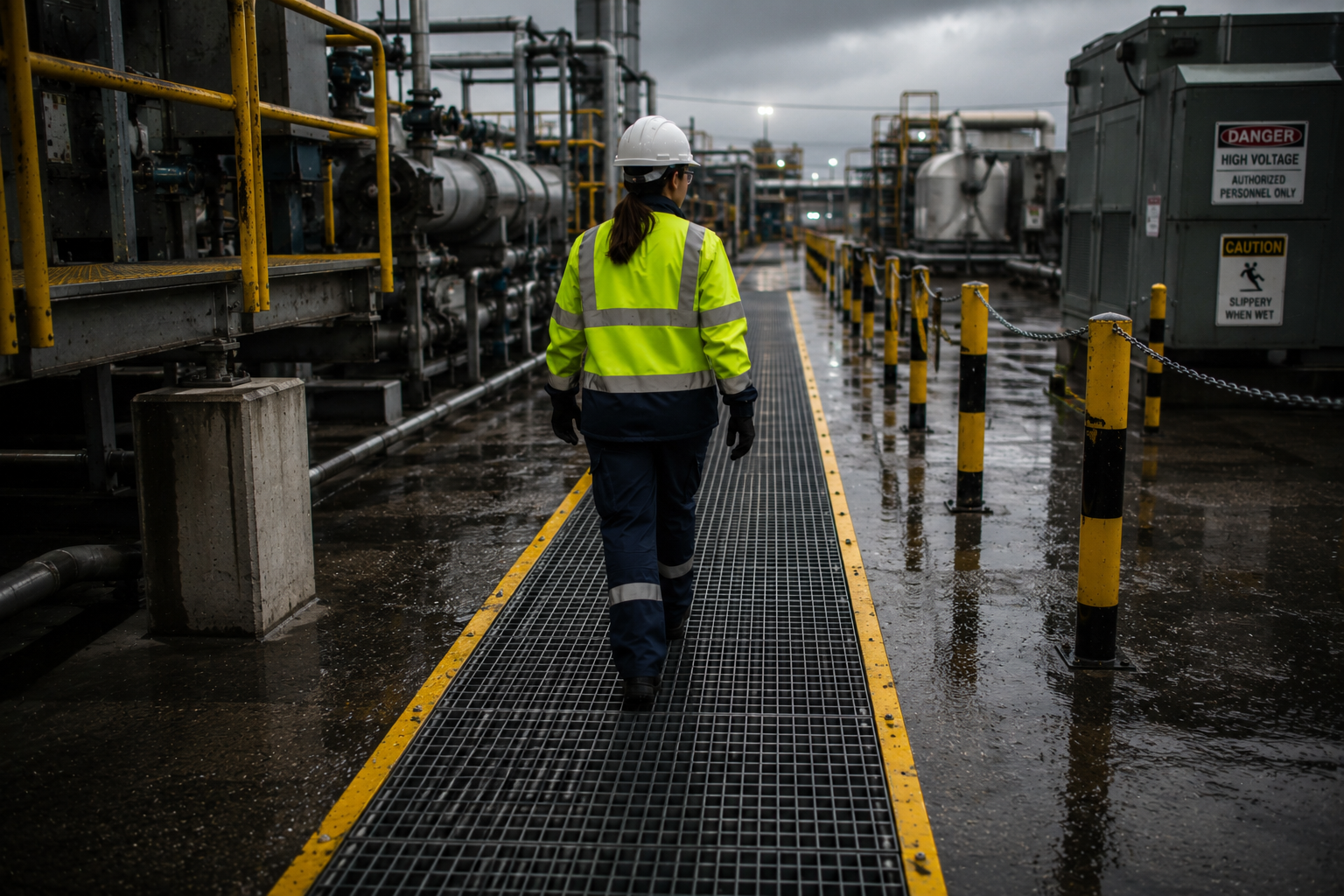
Your outdoor route hasn't changed. Everything around it has.
A clear walkway can quickly become harder to navigate when maintenance starts, cables are introduced, vehicles move through the area or wet weather changes the ground conditions.
That is why outdoor access safety starts with the route, not the product.
For facilities and maintenance managers, the challenge is understanding what has changed, who needs access and which solution best fits the problem. This guide will help you assess the route, compare your options and make a more informed choice.
In this guide
- Assessing outdoor pedestrian routes
- Choosing the right outdoor access solution
- What to check before you choose
- A worked example of a maintenance access route
- Frequently asked questions
- What to send us when you need advice
- When should an access route be reassessed?
Assessing outdoor pedestrian routes
Before choosing a solution, walk the route.
Not on the best day. Think about it when the site is busy, maintenance is underway or the British weather has done its worst.
The HSE advises that workplace traffic routes should be suitable for their intended use, with factors such as surface condition, drainage and pedestrian and vehicle movements considered as part of workplace transport safety.
Start with five questions:
- Who uses the route – pedestrians, vehicles or both?
- What is the surface like, particularly after wet weather?
- Are pipes, cables, hoses or other obstacles in the way?
- Is the obstacle permanent or temporary?
- Has maintenance, equipment or other site activity changed how people move through the area?
Then look closer. Check visibility, available space, drainage and the dimensions of any obstacles. Take photographs and measurements where needed.
The important part is not simply spotting a hazard. It is understanding what is creating the access problem.
A fixed pipe, a temporary cable and a muddy route might all make access more difficult, but they do not need the same solution.
Choosing the Right Outdoor Access Solution
There is no single product for every outdoor access problem – and there shouldn't be.
The right solution depends on what is actually stopping people from moving through the area safely and efficiently.
Before adding anything, ask the simplest question first: can the obstacle be removed or the route changed without creating another problem?
If not, match the solution to the challenge.
| Access problem | COBA solution to consider | Check before choosing | Limitations and suitability considerations |
| Fixed pipes, trunking or cable containment across a pedestrian route | COBAGRiP® Stepover | Obstacle height and width, available space, intended users and load requirements | Only consider where a suitable pedestrian crossing is needed and the obstacle dimensions, available space and product specifications are compatible. |
| Temporary cables or larger cables crossing an access area | CablePro HD | Cable diameter, number of cables, pedestrian/wheeled traffic and route conditions | Cable diameter and quantity must fit within the available channels. Not all cable protectors are suitable for the same traffic, so check the product's documented load capacity and intended use before selection. |
| Soft, muddy or unstable ground | COBATrack ground protection range | Ground conditions, intended traffic, expected load, route length and terrain | Not all ground protection mats are suitable for heavy vehicles or equipment. Ground conditions, expected loads and the product's installation requirements must be considered before selecting a suitable option. |
The distinction matters.
A cable protector won't solve unstable ground. Ground protection won't get someone over fixed pipework. And a stepover isn't automatically the answer simply because something is blocking a route.
Crossing Fixed Pipework and Cable Trays
Some obstacles aren't going anywhere.
Fixed pipework, cable containment and trunking can leave facilities teams with a simple problem: people still need to get from one side to the other without getting injured.
This is where COBAGRiP® Stepover comes in.
The free-standing GRP system creates a defined crossing over pipes and cables in industrial and commercial environments. Its quartz-grit surface provides slip resistance, while three standard sizes accommodate different applications:
- 464 mm × 995 mm × 132 mm
- 464 mm × 995 mm × 182 mm
- 464 mm × 995 mm × 233 mm
COBAGRiP® Stepover has been slip tested to EN 16165:2021 Annex B and fire tested to EN 13501-1:2018, with a stated Uniformly Distributed Load of 184 kg.
Start with the measurements.
Measure the obstacle and available space first, then compare those measurements with the relevant Stepover specification.
Explore the COBAGRiP® Stepover to compare available sizes, technical specifications and suitability for your application.
COBAGRiP® StepoverManaging Temporary Cables and Hoses
Temporary doesn't mean insignificant.
Maintenance, events and changing site operations can introduce cables into areas that normally remain clear. Where they cannot be routed away from the access area, the protection needs to suit both the cable and the traffic crossing it.
For heavier-duty outdoor applications, CablePro HD is designed for larger cables and areas with wheeled traffic. It uses 23 mm channels, tough ramped edges and is suitable for indoor and outdoor environments.
The wider CablePro range includes options for different applications, including CablePro GP and CablePro Mat
Don't choose on appearance alone.
Look at:
- how many cables need to pass through;
- their diameter;
- whether people, trolleys, forklifts or vehicles will cross the area; and
- whether the specific product is documented for outdoor use.
The cable is only half the story. What crosses it matters too.
Creating Temporary Access Over Soft Ground
Sometimes the obstacle isn't sitting on the route. It is the route.
Rain, repeated traffic and maintenance activity can turn grass or soil into soft, muddy or unstable access.
That calls for ground protection rather than an obstacle-crossing product.
The COBATrack range includes different ground protection products, including COBATrack Mat, COBATrack HD Mat and COBATrack Tile. COBA also provides separate datasheets for these products, reflecting their different applications and specifications.
Start by establishing what the route needs to carry. A temporary pedestrian walkway and an access route for heavy equipment are two very different jobs.
Consider the ground condition, terrain, route length and intended traffic before choosing. Then check the product-specific load information, connection method and installation requirements.
Not sure which option suits your site? Explore our ground protection range to compare solutions for different ground conditions, traffic and applications.
Explore Our Ground Protection Range
What to Check Before You Choose
You've identified the problem. You've narrowed down the solution. Now make sure it fits the site.
Before specifying a product, check three things:
1. Does it physically fit?
Measure the obstacle, route and available clearance.
For COBAGRiP® Stepover, that means checking the pipe or cable dimensions against the relevant Stepover size – not assuming that one model will fit every application.
2. Who or what will cross it?
Pedestrians, trolleys, forklifts and vehicles place very different demands on an access solution.
Check the intended use and relevant load information before making your selection.
3. Will it work in your environment?
Look at the surface, installation method, weather exposure and maintenance requirements.
Product suitability should be checked against the actual application, not just the problem it appears to solve.