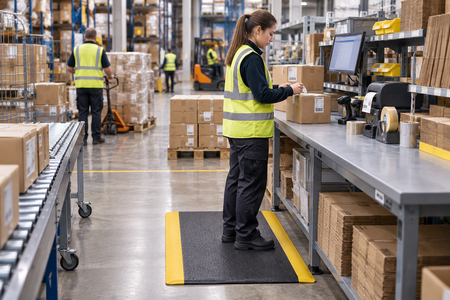
When warehouse volumes increase, almost everything gets a plan. Stock levels are checked, staffing is reviewed, packing materials are ordered, carrier collections are scheduled and throughput targets are set.
Yet one part of operational planning can be surprisingly easy to overlook: the workstation your team will be standing at while they make all of it happen.
Whether increased demand is driven by seasonal peaks, promotions, sales events or business growth, higher order volumes can change how people use fixed workstations. Employees may spend longer periods on their feet while completing repetitive picking, packing, checking and labelling tasks.
Preparing for increased demand therefore shouldn't stop at stock, staffing and throughput. The workstation itself deserves a place in the plan.
More Orders Mean More Work at the Workstation
Before an order reaches a customer, someone has to pick it, check it, pack it, label it and prepare it for dispatch.
When order volumes rise, your team may perform these tasks more frequently or for longer periods during their shift.
For someone working at a packing workstation, that can mean repetitive movements combined with significant periods spent standing in one place.
As well as asking how many orders your operation can process, it is worth considering how the workstations your team uses will perform when demand increases.
Look at Where Your Team Stops
Warehouses are designed around movement. Goods arrive, stock moves through the building and orders make their way towards dispatch.
Some of the most important work, however, happens where people stop.
Packing benches, sorting areas, inspection points and other fixed warehouse workstations can require employees to remain in broadly the same position for extended periods.
When reviewing these areas, consider:
- How long does your team typically spend standing here?
- Is that likely to increase when order volumes rise?
- What surface are they standing on?
- Are frequently used tools and materials within comfortable reach?
- Does the task involve repeated reaching, twisting or bending?
- Is there enough space to complete the task comfortably and safely?
- Could additional stock, packaging or equipment create obstructions or trip hazards?
A workstation that works well at one level of throughput may face different demands when volumes increase.
Think Beyond Throughput
Preparing a workstation for increased demand isn't simply about making it possible to process more orders.
How the workstation is organised, how the task is structured and how the working environment is set up can all influence the experience of prolonged standing at work.
Good warehouse ergonomics means considering the workstation as a whole. This can include the height and layout of the working area, the position of frequently used items, the movements involved in completing the task and opportunities to vary posture or activity where practical.
The surface underfoot is part of that picture too.
Where employees spend significant periods standing at work, anti-fatigue matting can help provide a more comfortable standing surface and form part of a wider approach to managing prolonged standing.
It is important to see matting as one element of workstation preparation rather than the entire solution. A mat won't correct a poorly arranged workstation, just as a well-organised workstation doesn't mean the surface someone stands on should be overlooked.
If you're unfamiliar with how anti-fatigue matting works, our guide to what is anti-fatigue matting? explains the principles, applications and factors to consider.
Give Your Standing Workstations a Check
You don't need to wait for an exceptionally busy period to review your workstations.
Regularly looking at fixed working areas can help you identify where the environment may need to adapt as workloads, processes or order volumes change.
1. Check the working area
Look at the space around each fixed workstation from the perspective of the person using it.
Additional stock, packaging, roll cages and equipment can gradually find their way into areas that are normally relatively clear. Consider whether employees have sufficient space to carry out their tasks and whether access routes around the workstation remain unobstructed.

2. Review frequently used equipment
Think about the items your team may reach for hundreds of times during a shift, such as scanners, labels, tape, packaging and tools.
Where practical, frequently used items should be positioned with the task in mind. Small inefficiencies can become much more noticeable when the same movement is repeated throughout a shift.
3. Consider prolonged standing
Identify the workstations where employees spend the greatest amount of time on their feet and consider whether workloads or changing order volumes could increase that time.
Where practical, opportunities to vary tasks, posture or movement can form part of a wider approach to managing prolonged standing. At fixed standing areas, also consider whether the surface underfoot is appropriate for the task.
4. Look at what's underfoot
The right standing surface depends on the environment.
A dry packing workstation may have different requirements from an area exposed to moisture, oils or other contaminants. Cleaning requirements, traffic levels and the space available can also influence which type of matting is appropriate.
Rather than choosing a mat first, start by understanding what's happening at the workstation and what you need the mat to do.
5. Ask Your Team
A workstation can look perfectly functional during a quick walk-through. The person spending several hours working there may have a different perspective.
Ask your team about the practical experience of using the workstation. Are they repeatedly reaching for something? Does packaging accumulate in the wrong place? Are there tasks that become more difficult when volumes increase? Are there areas where they spend particularly long periods standing?
Their experience can help identify friction points that aren't always obvious from observation alone.
6. Review Workstations as Your Operation Changes
A workstation isn't necessarily a one-time setup.
Changes in order volumes, processes, equipment or working practices can alter how an area is used. Revisiting fixed workstations periodically gives you an opportunity to identify whether they are still suited to the people and tasks they support.
Choose Matting for the Workstation, Not Just the Warehouse
There isn't one anti-fatigue mat that's right for every standing workstation.
The best starting point is the application itself.
Consider the environment, the task, the amount of time spent standing, traffic around the workstation, cleaning requirements and any contaminants the mat may encounter.
COBA offers different anti-fatigue solutions for different workplace requirements. Orthomat® Premium, Deckplate® ReGen and Tough-Lock Anti-Fatigue, for example, each have characteristics suited to different applications.
This is where COBA's experience can help. Rather than starting with a product and trying to make it fit the application, we can help you understand the demands of your workstation and narrow down the options suited to it.
If you're unsure where to begin, you can find the right mat for your workstation using MatBrain™.
Look at Value as Well as Price
Purchase price will naturally form part of any investment decision, but it doesn't always tell the full story.
If you're considering anti-fatigue matting for employees who spend significant periods standing at fixed workstations, it can also be useful to explore the potential business value of that investment.
COBA's ROI Calculator can help you calculate the potential value of anti-fatigue matting for your workplace, giving you another way to assess the decision beyond the initial product price.
Prepare Your Workstations for What's Next
You don't need to know exactly when your next increase in demand will arrive to make workstation preparation worthwhile.
Look at where your team spends the most time standing. Talk to the people who use those areas. Consider how the workstation performs as workloads change and whether there are improvements that could better support the task.
Because preparing a warehouse for increased demand isn't only about how much you can move through it.
It's also about the places where your team makes that happen.