
A warehouse floor has to support almost everything your operation does.
Goods arrive and leave. Pallet trucks and trolleys move through the building. Employees pick orders, pack products and prepare shipments for dispatch. Some people spend much of their shift moving, while others may spend hours standing at the same workstation.
Although all of this happens under one roof, the demands placed on the floor can be very different from one area to another.
That means choosing warehouse floor mats shouldn't start with finding one product for the entire building. It should start with understanding how each area is used, who works there and what you need the matting to achieve.
This guide explores the different considerations across warehouses and distribution centres and how to choose matting for the job rather than simply the building.
Start With What Happens on the Floor
Walk through your warehouse and consider how often the working environment changes.
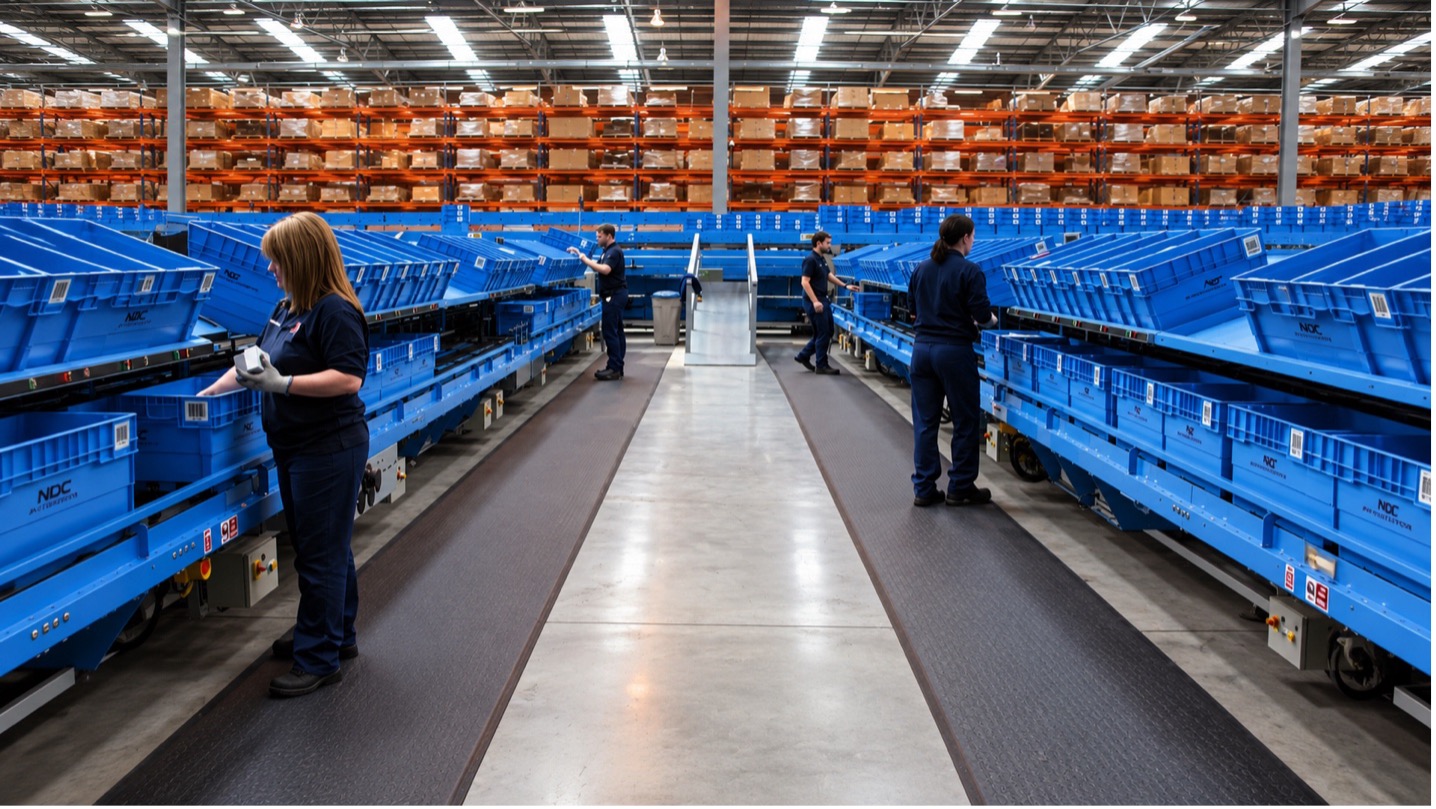
A packing employee may spend significant periods standing at a fixed workstation. A nearby pedestrian route could experience constant foot traffic. In another area, people may need to move between several adjoining workstations or regularly reconfigure the space.
Each area presents a different requirement.
Before comparing warehouse mats, consider:
- What task takes place in the area?
- How much time do employees spend standing there?
- Is the workstation fixed or does the layout change?
- How much pedestrian traffic does the area experience?
- Will trolleys or other wheeled equipment be used nearby?
- Is the environment predominantly dry?
- Could oils, moisture or other contaminants be present?
- How will the matting be cleaned?
- How much floor area needs to be covered?
- Does the matting need to be moved or reconfigured?
These questions help turn a broad search for warehouse matting into a much more useful question: what does this particular area need?
Fixed Workstations Have Different Demands
Packing, checking, sorting and inspection stations are an important part of many warehouse and distribution operations.
While the goods keep moving, the employee completing the task may spend a significant amount of time standing in broadly the same place.
Where prolonged standing is part of the job, anti-fatigue matting can help provide a more comfortable standing surface and form part of a wider approach to workstation design.
For dry fixed workstations, Orthomat® Premium is one anti-fatigue option designed for employees who spend long periods standing.
The right solution should still be selected according to the individual application. Consider how long the workstation is used, the amount of movement involved in the task, the available space and any other conditions the mat will encounter.
Our guide to preparing warehouse workstations for increased demand explores the wider workstation considerations around prolonged standing, repetitive tasks and changing order volumes.
When the Environment Asks More of the Mat
Not every warehouse workstation operates under the same conditions.
Some areas may experience heavier use, different levels of traffic or working conditions that demand more from the surface underfoot.
This is where looking beyond the basic requirement for a standing surface becomes important.
Deckplate® ReGen provides an anti-fatigue solution for demanding industrial workplaces where durability and standing comfort are important considerations.
Rather than choosing a mat because it appears more heavy-duty, however, consider what is actually happening in the application. Think about traffic, contaminants, cleaning requirements and how employees use the area during a normal working day.
A product specification is most useful when you know which workplace requirement you need it to meet.
What if One Mat Isn't Enough?
Some warehouse operations need more than a single workstation mat.
You may have a row of packing stations, a larger assembly or processing area, or a workspace where the layout needs to adapt as operational requirements change.
In these situations, modular matting can allow a larger standing area to be created from individual sections.
Tough-Lock Anti-Fatigue is designed as an interlocking solution, making it possible to configure matting around the size and layout of the working area.
This can be useful where standard mat sizes don't suit the application or where a larger continuous standing surface is required.
When considering modular warehouse matting, think about the total area you need to cover, where employees stand and move, the position of equipment and whether the layout may need to change in future.
The objective isn't to cover as much floor as possible. It's to provide an appropriate standing surface where your team actually needs it.
Think About People and Traffic Separately
One of the easiest mistakes when assessing a warehouse floor is treating every area with heavy activity as the same type of application.
It isn't.
A person standing at a packing bench for several hours creates a different requirement from people regularly walking through a pedestrian route. An area used by wheeled equipment creates another set of considerations.
This distinction matters when choosing warehouse anti fatigue mats.
Anti-fatigue matting is primarily relevant where employees spend significant periods standing, particularly at fixed or defined workstations. It shouldn't automatically be placed across traffic routes simply because those areas are busy.
Map where your team stands, where they walk and where equipment moves before deciding where matting is required.
That simple exercise can help you focus the solution on the actual workplace problem.
Consider Wheeled Equipment Before Choosing Matting
Warehouses and distribution centres frequently use pallet trucks, trolleys, cages and other wheeled equipment.
If this equipment needs to travel across or close to a matted area, consider that requirement before selecting a product.
Not every anti-fatigue mat is designed for wheeled traffic, and repeatedly moving equipment over an unsuitable product can affect both usability and product life.
Look at how people and equipment move around the workstation during a normal shift. If wheeled access is required, check the suitability of the specific matting solution for that application rather than assuming that all warehouse floor mats will perform in the same way.
The route around the workstation matters just as much as the place where someone stands.
A Busy Warehouse Still Needs Clear Working Areas
Increased activity can gradually change how a warehouse floor is used.
Packaging accumulates beside workstations. Roll cages are temporarily parked in convenient spaces. Additional stock appears near packing areas. Equipment moves as processes change.
Matting needs to work within that environment rather than becoming another obstruction.
When positioning a mat, consider whether:
- Its size is appropriate for the working area.
- The edges are suitable for the application.
- It interferes with pedestrian routes.
- It creates an issue for nearby wheeled traffic.
- Employees can work naturally within the matted area.
- It can be cleaned and maintained appropriately.
- The surrounding floor remains clear and accessible.
Good matting selection isn't only about the properties of the mat. Where and how you use it matters too.
Don't Choose Warehouse Matting on Price Alone
Two mats can look similar on a procurement spreadsheet while being designed for very different applications.
That makes initial purchase price difficult to assess without first understanding what you need from the product.
A lower-cost solution may not represent better value if it isn't suited to the working environment, the amount of use it will receive or the task being carried out.
Start with the application and narrow down products that meet those requirements. Price can then form part of a comparison between suitable options rather than determining the shortlist from the beginning.
If you're building a business case specifically for anti-fatigue matting, COBA's Anti-Fatigue Matting ROI Calculator can also help you explore the potential value of anti-fatigue matting within your workplace.
One Warehouse Can Need More Than One Solution
Imagine following an order through your warehouse.
It moves from storage to picking, then perhaps to a checking station before reaching packing and dispatch.
The product keeps moving, but the people handling it interact with the floor in different ways along the journey.
A fixed packing workstation may benefit from an individual anti-fatigue mat. A more demanding standing area may require a different specification. A larger group of adjoining workstations could be better suited to a modular solution.
It's one warehouse, but there isn't necessarily one matting requirement.
| Warehouse area | What to consider | Potential solution |
| Dry fixed packing or checking workstation | Prolonged standing, workstation size and employee movement | Orthomat® Premium or another suitable anti-fatigue mat |
| More demanding industrial workstation | Prolonged standing, durability and working conditions | Deckplate® ReGen where appropriate |
| Larger or configurable workstation area | Area size, layout and need for modular coverage | Tough-Lock Anti-Fatigue |
| Pedestrian or equipment route | Traffic type, wheeled equipment and floor conditions | Assess separately according to the application |
This isn't intended as a substitute for assessing your individual workplace. Instead, it shows why starting with the application is more useful than looking for one universal warehouse mat.
Find the Right Mat for Your Warehouse
There isn't one warehouse floor mat that's right for every distribution centre, workstation or application.
There shouldn't be.
The right solution depends on what happens in that particular area: how long people spend standing, how they move, the traffic around them, the size of the workstation and the demands placed on the matting.
At COBA, we encourage you to start with those questions rather than the product catalogue.
Our experience in workplace matting can help you understand the demands of your application and narrow down the options suited to your environment.
You can also find the right mat for your warehouse with MatBrain™. Answer a few questions about your workplace and application to identify matting options suited to your requirements.