Workplace Safety Matting
COBA > Workplace Safety Matting
NEW Full-line Catalogue - Now available - Take a look
 GB
Our working mats product range includes anti-fatigue matting and slip resistant mats to suit a wide variety of budgets and needs. The latest COBA catalogue is the most comprehensive to date. It includes information on our entire safety floor matting product range along with case studies and buying advice.
Please select the sample you'd like for this product
We offer site surveys throughout the UK and Europe, often accompanying our distributors. Our experienced sales team will visit your premises in order to assess your specific working environment and associated risk factors. Using this information we will then be able to recommend the most effective floor level safety solutions

Introducing safety matting to the workplace can create a safer working environment and improve productivity. However, having the right type of matting in place is important for it to be effective. To solve this problem, we have a wide variety of safety matting to suit different applications and budgets.
For example, ESD Matting is required to protect individuals and components from Electrostatic Discharge (ESD), as regular rubber matting won’t offer the same level of protection.
Industries such as food processing also require specific types of matting with anti-microbial properties, to cope with grease, oils, fats and detergents, to effectively keep employees safe.
Heavy industrial environments may require tougher rubber safety mats with higher anti fatigue ratings, to combat Musculoskeletal Disorders (MSDs) from standing in static positions.
There are also safety mats designed for the leisure industry to keep the public safe from slips and trips at swimming pools and changing rooms. These types of mats are comfortable to walk on barefoot and reduce slipping on wet surfaces. Gym and weight room safety mats are designed to reduce noise levels, provide stability underfoot, and floor protection from machines and weights.
If you need help choosing the right matting, our handy MatBrain™ tool is a useful tool that helps to narrow down the ideal matting options for your requirements.
We’ve compiled answers to frequently asked questions about workplace safety mats:
Yes, many industrial work mats are designed to be resistant to chemicals and oils commonly found in industrial settings. Mats made from materials like rubber, PVC, or nitrile are often chosen for their durability and ability to withstand spills of oils, grease, solvents, and other chemicals without degrading. This makes industrial Work mats ideal for environments like automotive workshops, factories, and chemical processing plants, where such substances are frequently present. However, it's important to check the specific mat's material specifications to ensure it is suitable for the chemicals you'll be using.
Not as such. However, as part of the Health and Safety at Work Act, employers are responsible for ensuring that workplace floors are safe. This includes taking measures to reduce the risk of slips, trips and falls for employees and visitors. General health and wellbeing is a factor too. If workers have to regularly stand for prolonged periods of time in their occupation, then an employer may consider anti-fatigue mats to reduce the risk of musculoskeletal disorders (MSDs) but this is only a recommendation, rather than legislation.
Any building open to the public also has a legal obligation to ensure its floor surfaces are safe for visitors/customers, as failure to comply, could lead to compensation claims from any individual who has an accident, such as slip on an unsafe floor. Entrances to new buildings should also comply with Buildings Regulations (England and Wales) Part M and the requirements of The Equality Act 2010. (Please refer to the full document for detailed information relating to the purpose of the building.) This means buildings should be accessible to all people regardless of disability, age or gender. It requires ‘reasonable adjustments to be made for accessibility’ to certain buildings. Entrance mats should not impede wheelchair access, and the matting should be level with the floor surface.
Our wear ratings are for guidelines only and illustrated with foot symbol. 5 ‘yellow dots’ signal the highest wear rating, meaning these products are suitable for heavy-duty use. ‘3’ is for moderate and 1 ‘yellow dot’ is for lightweight use only. Each environment is different and some locations may be more punishing than others. Our wear ratings are there to give you some guidance on each product’s durability. If you need further assistance, please get in touch with our Customer Service team.
Modular matting refers to any mat that is made of interlocking components. This could be interlocking floor tiles or sections of matting. Examples include Comfort-Lock, High-Duty, Fatigue-Step, Flexi-Deck, Bubblemat. They are useful because they can be linked together to cover different floor sizes, and as they are in sections, they are easy to handle and move around if need. If required, individual sections or tiles can be removed and replaced.
Safety mats are useful for a variety of applications. For example, they can be used as a dry shoe surface to avoid slips or as matting to safeguard workplace trips. Wet area mats, kitchen mats, anti-fatigue mats, and non-slip floor mats are all categorised as safety mats because of their unique properties that provide security for employees or guests in your facility.
Industrial safety matting includes anti-fatigue mats, non-slip mats, drainage mats, and chemical-resistant mats. Each type is designed to address specific safety and comfort needs in various industrial applications.
When selecting industrial mats, consider factors such as your workplace's specific needs, the types of activities performed, and the level of foot traffic. Look for mats with the necessary features, such as anti-fatigue, anti-slip, or chemical resistance.
Our Matbrain decision tree will assist you in finding the best industrial mat that is suited for your site.
Any matting that is mostly utilised in an industrial setting is referred to as an industrial floor mat. Workshops, factories, warehouses, assembly lines, and welding bays are all included in this. To withstand the frequently harsh circumstances they must withstand, industrial matting is typically composed of rubber, PVC, or other durable materials.
With characteristics including non-slip surfaces, bevelled edges, puncture resistance, and anti-fatigue construction, we have a variety of industrial floor mats designed for the workplace.
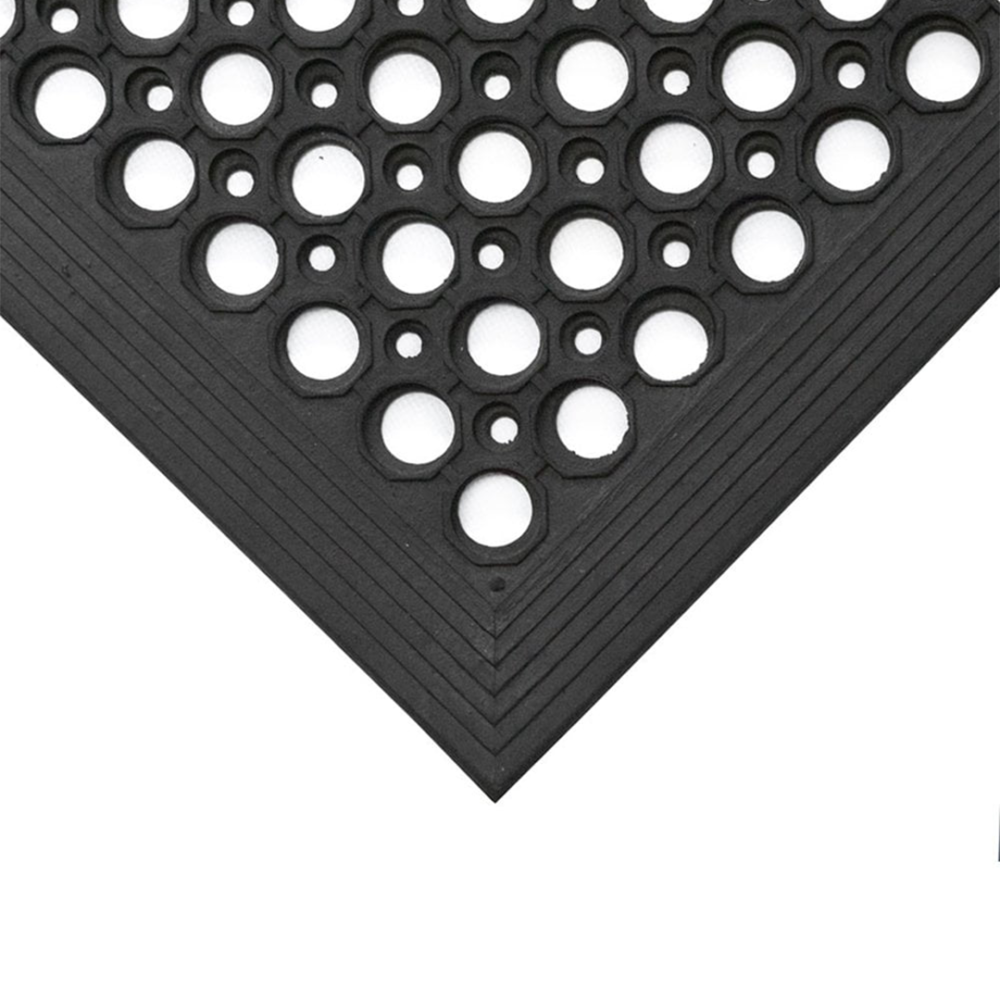
Where there is swarf present, it is always advisable to opt for open hole mats rather than those with solid surfaces. Open hole designs, such as COBAmat® allow swarf to fall ‘through’ the mat. Loose swarf on a solid surface mat can become a safety hazard, and sharp debris can pierce or stick into the mat’s surface, damaging the mat depending on the product that you have.
If it sits too ‘proud’ from the ground and doesn’t have bevelled (ramped) edges, then yes matting can sometimes cause a trip hazard. The thicker (deeper) the mat, the more essential it is to have bevelled edges to reduce the risks of tripping. Many of our workplace mats have tapered edges as standard, or we offer bevelled edging as an option. With some mats it is possible to install them in recessed wells which means they are flush to the ground. This too is an option to overcome any trip risks. Some of our edging is available in bright yellow, for maximum safety awareness.
Forklift trucks will damage most mats. This normally occurs when the wheels are turned on the product. Tough-Lock Tiles can be used in conjunction with forklifts, but we suggest bonding the tiles to the floor for the best performance. The Superdry Heavy Traffic is also perfect for forklift traffic,, and is also referred to as Forklift Truck Matting.
Yes — COBA’s solutions can support compliance with workplace safety regulations by helping businesses reduce risks associated with fatigue, slips, trips, and other hazards that impact employee well-being.
In short: while COBA solutions don’t replace formal compliance processes, they provide practical tools that help employers demonstrate proactive steps toward workplace safety regulation compliance.
Get the latest floor safety articles, product updates and offers.