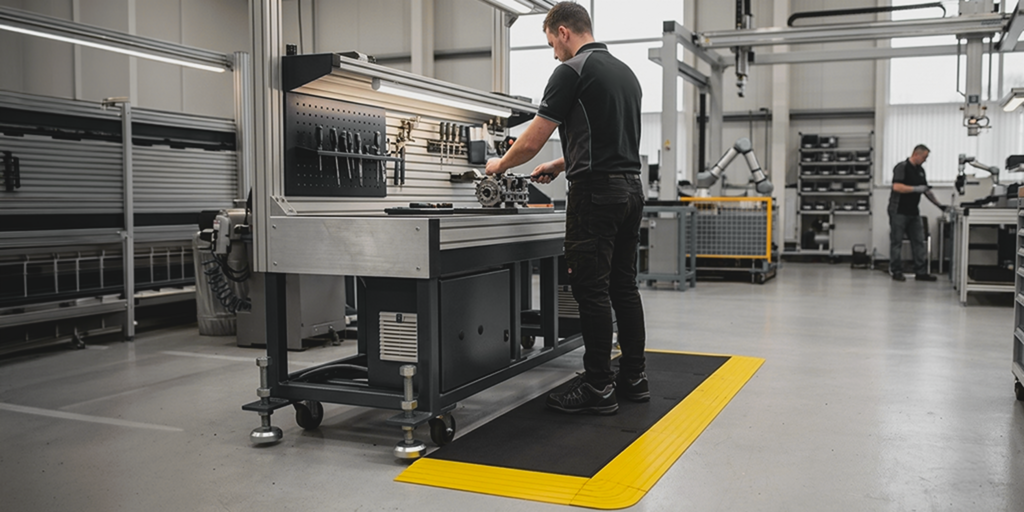
When was the last time your organisation reviewed the floor?
- Not the machinery.
- Not the PPE.
- Not the safety signage.
The floor.
It sounds like an unusual question, yet it highlights a surprising blind spot in many manufacturing and logistics environments.
Most workplace safety programmes focus on obvious risks. Forklifts are inspected. Machinery is maintained. Employees receive training. These are all essential parts of a strong safety culture.
Yet one of the most used assets in any facility often receives far less attention.
Every employee stands on it. Walks across it. Works from it.
And most businesses rarely think about it until something goes wrong.
The Asset Everyone Uses But Nobody Owns
The floor occupies a strange position within many organisations.
It is everywhere, yet often nobody feels directly responsible for it.
Unlike machinery, flooring rarely appears on performance dashboards. Unlike PPE, it is not issued to employees. Unlike vehicles, it is not routinely inspected before use.
As a result, flooring and underfoot conditions can become part of the background.
Until they become a problem.
- A wet area creates a slip hazard.
- A hard standing workstation contributes to discomfort during long shifts.
- A worn surface increases risk in a high-traffic environment.
The issue is not that businesses ignore safety. The issue is that some risks become so familiar that they disappear from view.


Why Familiar Risks Are Often the Most Dangerous
Human beings are remarkably good at adapting.
In the workplace, this can be both a strength and a weakness.
Employees become accustomed to standing for long periods. Managers become accustomed to seeing teams work in the same environment every day. What was once noticeable gradually becomes normal.
This phenomenon can make underfoot risks difficult to identify.
After all, nobody walks into a facility and immediately thinks:
“Let’s talk about the floor.”
Yet underfoot conditions influence how people move, work and feel throughout the day.
The impact may not always be dramatic.
More often, it appears as small issues that accumulate over time:
- Increased discomfort during long shifts
- Reduced concentration
- Higher physical strain
- Greater slip potential in problem areas
- Lower overall workplace wellbeing
Individually, these may seem minor.
Collectively, they can influence workplace performance far more than many organisations realise.
Looking Beyond Compliance
The most effective safety cultures do more than meet compliance requirements.
- They challenge assumptions.
- They ask questions that others overlook.
- They look for risks hiding in plain sight.
Underfoot safety is one of those opportunities.
Rather than viewing flooring as simply part of the building, leading organisations increasingly recognise it as part of the working environment itself.
The surface employees stand on influences comfort, movement, safety and productivity every single day.
Ignoring it does not make the impact disappear.
It simply makes the impact harder to see.

Safety Starts From the Ground Up
Workplace safety is often discussed from the top down.
- Leadership.
- Training.
- Procedures.
- Culture.
All are important.
But perhaps one of the most overlooked elements of workplace safety has been beneath our feet all along.
Because the floor is not just a surface.
It is part of every shift, every task and every movement within a facility.
And when organisations start paying attention to underfoot safety, they often discover that some of the biggest opportunities for improvement were right in front of them all along.
Or more accurately, right beneath them.