Sustainability in manufacturing is rarely straightforward, especially when your core materials include rubber and plastics. At COBA, we approach it with honesty and continuous improvement.
As a business rooted in safety, performance and longevity, our challenge has always been balancing durability with environmental responsibility. Mats are designed to work hard, minimise replacement
cycles and protect people, and that durability is, in itself, part of the sustainability equation.“There’s
no value in pretending our products are made from air and goodwill,” says James Alcock, Operations Manager at COBA.
“What matters is how responsibly we source, design, manufacture and audit every step of not just our processes but those of our suppliers too.”
Sustainable Material Choices in Anti-Fatigue Mat
Manufacturing
Many of our anti-fatigue mats are manufactured using high-performance polypropylene and rubber compounds. Polypropylene is highly durable, lightweight, resistant to moisture and chemicals and its long service life means products don’t need to be replaced frequently, reducing overall material consumption and waste over time.
A significant proportion of our portfolio also incorporates recycled high-density polyethylene (HDPE). HDPE is widely recycled and retains excellent structural integrity after reprocessing. This allows us to divert material from landfill while maintaining the industrial-grade performance required in manufacturing, warehousing and production facilities.
We also use:
- Recycled factory waste
- Regenerated production offcuts
- Recycled plastic bottles
All materials are rigorously tested to ensure they meet COBA’s safety, slip resistance and anti-fatigue performance standards. Sustainability without durability simply shifts the environmental burden further down the line.
Why Durability Matters in Anti-Fatigue Matting
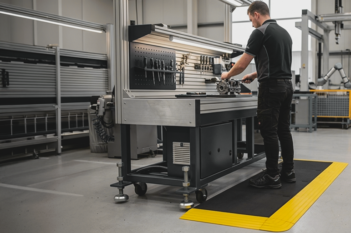
In industrial environments, anti-fatigue matting supports workers who stand for extended periods on hard floors such as concrete. Poor-quality mats break down quickly, leading to unnecessary waste, increased replacement costs and potential safety risks.
By designing long-lasting industrial anti-fatigue mats, we reduce product turnover and extend lifecycle value. Fewer replacements mean reduced material consumption and lower environmental impact over time.
Correct specification of anti-fatigue matting also plays a role in reducing workplace fatigue and supporting musculoskeletal health in manufacturing and distribution settings.
For distributors operating within the health and safety sector, durable and responsibly manufactured anti-fatigue solutions provide confidence when specifying products into regulated environments.
Reduce, Reuse, Recycle in Practice

Our commitment to the reduce, reuse, recycle hierarchy is embedded into our operations.
Our bespoke manufacturing service ensures customers receive matting tailored precisely to their environment. This reduces unnecessary offcuts and excess material waste. Combined with professional installation services, on-site waste is minimised and product lifespan is maximised.
Just as importantly, we prioritise correct product selection from the outset.
Our buying guides and Perfect Entrance Journey approach help distributors and end users specify the right solution for the right application. Getting it right first time avoids premature wear, unnecessary disposal and costly replacements.
“The most sustainable product is the one you don’t have to replace,” explains Chris Stanley, Group Commercial Director. “That’s why guidance, education and specification are just as important as the materials themselves.”
Responsible Sourcing and Supplier Auditing
Sustainability in rubber and plastics manufacturing extends beyond the factory floor.
COBA carries out ongoing supplier audits, reviewing environmental practices, raw material sourcing and manufacturing standards. This due diligence ensures our supply chain aligns with our environmental and ethical expectations.
“We don’t believe in one-off audits or tick-box compliance,” says James.
“Our supply chain is reviewed regularly because responsibility does not expire once a
contract is signed.”
For health and safety distributors, this transparency strengthens supply chain credibility and supports responsible procurement decisions.
Reducing Our Operational Footprint
At our Rugby head office, sustainability is embedded in daily operations. We have invested in:
- Solar panels to reduce reliance on grid electricity
- Electric vehicle charging points to support lower-emission transport
- Structured internal recycling systems across offices and production areas
These initiatives reflect our belief that environmental responsibility starts internally before it ever reaches the customer.
The Future of Sustainable Industrial Matting
Working with rubber and plastics means sustainability is an ongoing journey. We continuously explore improved material formulations, enhanced manufacturing techniques and innovations that reduce environmental impact without compromising anti-fatigue performance or workplace safety.
“CSR isn’t about claiming perfection,” Chris adds.
“It’s about taking responsibility, making informed decisions and committing to doing
better year after year.”
At COBA, sustainability is not a marketing statement. It is an operational discipline built on transparency, durability and long-term accountability, supporting safer industrial workplaces through responsibly manufactured anti-fatigue matting.